
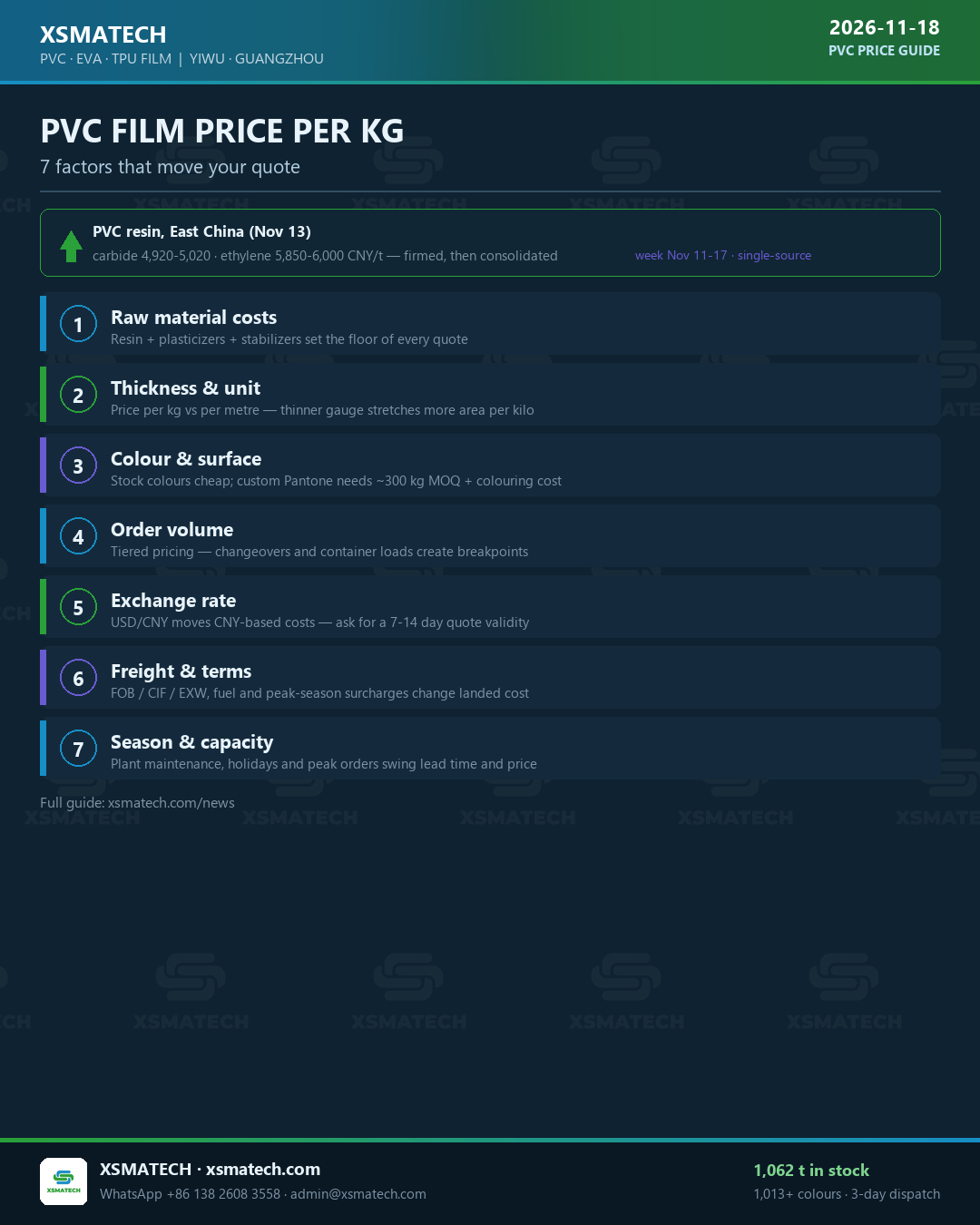
Ask three suppliers for the same PVC film spec and you will often get three prices spread 20–30% apart. None of them is necessarily wrong — each quote sits at a different point on seven moving factors: raw materials, thickness and unit, colour, volume, exchange rate, freight, and the season. Buyers who understand these factors stop comparing quotes blindly and start negotiating on the two or three that actually matter for their order.
This guide breaks down each factor in plain language, adds a snapshot of what the PVC market did last week, and ends with a short checklist for reading any film quote in five minutes.
Market snapshot: week of Nov 11–17
East China PVC resin spot prices stood at 4,920–5,020 CNY per tonne for the common carbide-based grade and 5,850–6,000 CNY per tonne for the ethylene-based grade (as of Nov 13). The domestic market firmed through the week in oscillation, then trading cooled after the rise; supply is expected to edge up as some plant maintenance ends while other units remain offline.
Data note: week of Nov 11–17, compiled from a single industry quote source — direction and levels only, not an offer. Always confirm current numbers with your supplier before ordering.
Why open with resin? Because it is the single biggest line inside your film price — which brings us to factor one.
Factor 1: Raw material costs — the floor of every quote
Flexible PVC film is a recipe: PVC resin, plasticizers (DOP/DOTP/DOA grades), stabilizers, and small amounts of other additives. Resin typically makes up the largest share of the cost stack, and for soft film the plasticizer package is the second heavy line. When resin moves — as it did last week — today’s quotes move with it, usually with a short lag. Energy prices feed in as well, because carbide-based resin is electricity-hungry.
Buyer takeaway: if resin has been rising for two straight weeks, a quote that does not move may simply be stale. Ask when the quote expires.
Factor 2: Thickness and the unit you quote in
PVC film is priced per kilogram, per metre, or per square metre — and the same roll can look cheap or expensive depending on the unit. Thinner gauge stretches more area out of every kilo, so “price per kg” rises as gauge falls even when material cost is flat. Yield matters too: edge trim, start-up waste and thickness tolerance all decide how many sellable metres come out of a tonne.
Buyer takeaway: always normalise quotes to the same unit and the same tolerance class before comparing. A tighter tolerance is worth a slightly higher per-kg number on a finished-goods line.
Factor 3: Colour, pattern and surface finish
Stock super-clear, frosted or black film sits near the bottom of the range because it runs continuously. Custom colours are different: the mixing line must be dedicated, the colouring cost amortised, and a minimum order applies — custom Pantone shades typically start around 300 kg. Special surfaces (glitter, printed, embossed, iridescent) add passes on the line and therefore cost.
Buyer takeaway: if a catalogue colour works, stay with it. Reserve custom colours for where they genuinely sell your product.
Factor 4: Order quantity and MOQ
Quotes move in steps, not curves. Below the minimum order quantity, the set-up cost of a run lands on few kilos; at container-load breakpoints, freight efficiency improves again. That is why 500 kg, 3 tonnes and a full container can each carry a different per-kg number for the identical film.
Buyer takeaway: when a quote feels high, ask what the next pricing breakpoint is. Sometimes adding one more roll to reach the step costs less than the price difference on the whole order.
Factor 5: Exchange rate
Chinese film is costed in CNY and sold in USD, so the rate moves the export price even when nothing changes inside the factory. Serious suppliers protect both sides with a quote validity window — commonly 7–14 days — and larger buyers align payments to the same window through channels such as XTransfer.
Buyer takeaway: check the validity date on every quote, and re-confirm before a long negotiation ends. An expired quote in a moving market is not a quote.
Factor 6: Freight and trade terms
EXW, FOB and CIF put different cost blocks inside the number: inland trucking, export clearance, ocean freight and insurance. On short legs — China to Haiphong or Ho Chi Minh City, for example — freight is a modest slice, but fuel adjustments and peak-season space tightness can still swing it. Missing a freight line in a CIF comparison is the classic way to compare two unequal quotes.
Buyer takeaway: compare like with like — same Incoterm, same destination port, same validity — or convert everything to landed cost first.
Factor 7: Season and the capacity cycle
Plant maintenance, public holidays and order peaks all move price and lead time together. Maintenance coming back online adds supply and cools the market, as expected in the week just past; holiday shutdowns do the opposite, which is why orders placed 6–8 weeks before major holidays enjoy both better pricing and saner schedules.
Buyer takeaway: plan repeat orders against the industry calendar, not just your production plan.
How to read a film quote in five minutes
- Spec table complete? Thickness, width, surface, application — with tolerance.
- Unit and basis clear? Per kg or per metre, Incoterm, port, packaging.
- Validity date printed? Seven to fourteen days is normal in a moving market.
- Colour reference agreed? Pantone or physical sample, with who keeps the retained sample.
- Documents listed? PI, CI, PL and customs code for smooth clearance.
What this means right now
With resin firmed and then consolidated this week and supply set to edge up, quotes should be broadly stable in the short term — but every one of the seven factors above can move it. Buyers with recurring volumes do best by locking a price window with their supplier instead of re-quoting from zero each time; that single habit removes most of the exchange-rate and resin noise from your landed cost.
How we quote
XSMATECH quotes PVC, EVA/PEVA and TPU film the way this article reads: spec table, tolerance, unit, Incoterm and validity on one page. Stock support runs around 1,062 tons / 134,683 yards across 1,013+ colours with 3-day dispatch; standard production, including sample confirmation, is 25 days, with custom-colour MOQ around 300 kg. Start by holding the material: reply “CARD” on our contact page or WhatsApp +86 138 2608 3558 and we ship a free A4 colour card (308 colours) worldwide — then a sample roll in your exact spec. Browse PVC film, EVA/PEVA film, TPU film, the ready-to-ship list or download technical data sheets.