
2026-11-19 · XSMATECH material guide
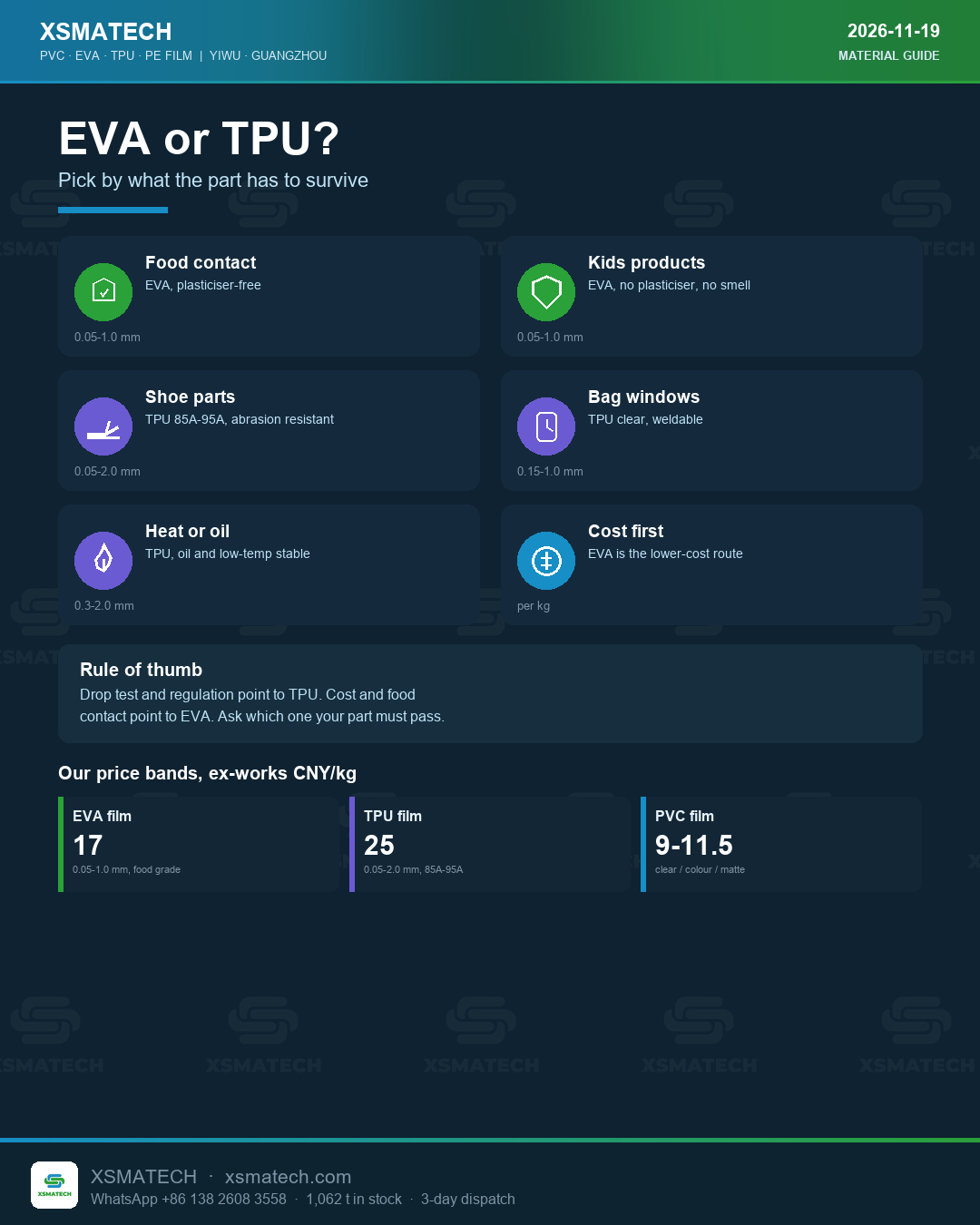
Buyers often ask us to quote “clear flexible film” and then choose on price alone. EVA and TPU are not interchangeable, and the price gap – roughly 17 CNY/kg against 25 CNY/kg – buys specific performance. Here is how the two materials actually differ in 2026.
1. Price and what drives it
EVA film, 0.05-1.0 mm: about 17 CNY/kg. Base resin: EVA foam and film grade, currently 10,900 CNY/t spot (Yangzi-BASF, 19 Nov 2026), down 5.6% in two weeks as solar encapsulation demand slowed. Resin is roughly two thirds of our price; the rest is calendering, packing and margin.
TPU film, 0.05-2.0 mm, 85A-95A: about 25 CNY/kg. TPU is a block copolymer of BDO, MDI and adipate polyol. All three moved up through the first half of 2026 – BDO on plant turnarounds, MDI on tight overseas supply – and TPU followed. Since September the market has been range-bound rather than trending, which is why our TPU quote has been stable while EVA has moved.
The practical point: EVA quotes move with one feedstock complex; TPU quotes move with three. If you need price stability for a season-long programme, TPU has been the steadier number this year, even though it is the more expensive one.
2. Where each one wins
EVA wins on: food contact and children’s products (plasticiser-free, low odour), cost-sensitive volume, soft-touch lamination, and packaging windows where the part does not flex hard in service.
TPU wins on: abrasion and flex fatigue (shoe uppers, soles, sports goods), transparency with weldability (bag windows, inflatables), oil and low-temperature resistance (industrial and automotive), and any part that gets a drop test or a chemical exposure test.
A simple filter we use with customers: if the finished part must pass a mechanical test, it is TPU. If it must pass a food-contact or cost test, it is EVA.
3. Competitive landscape
EVA: the high-volume grades are dominated by large Chinese producers – Yangzi-BASF, Sinopec affiliates, and the newer solar-grade lines at Sierbang and Lianhong. Film-grade converting is fragmented, with many small and mid-size calenderers; quality varies mostly in gel count, thickness tolerance and odour. That fragmentation is where a factory like ours competes: consistent gauge control and a documented food-contact file.
TPU: upstream is concentrated (BASF, Covestro, Lubrizol internationally; Wanhua, Huafeng, Miracll domestically). Film converting is again fragmented, but the entry barrier is higher than EVA because customers usually demand test data – hydrolysis resistance, yellowness after UV, adhesion after welding. A converter without those files cannot sell into footwear or automotive.
4. What we hold and how we quote
We run PVC, EVA, TPU and PE on eight calendering and blown-film lines in Yiwu, with 1,062 tonnes in stock across 94 grades. Stock colours ship in three days; production colours run 1-2 tonnes in 10-15 days. We load from Yiwu or Guangzhou and quote CIF from either port, and we can supply REACH, RoHS and EN 71-3 documentation with the sample.
If you send us the part drawing or a photo of the finished product, we will tell you which of the two materials it should be, and quote that one – rather than quoting both and letting price decide.
Contact: Oven Pan · admin@xsmatech.com · WhatsApp +86 138 2608 3558 · xsmatech.com
Prices are our current ex-works bands, subject to grade, colour and quantity. Feedstock references: Zhejiang Plastics Association spot releases (EVA, PVC) and Dalian Commodity Exchange settlement, 19 Nov 2026.