
When importers calculate landed cost, the pallet under the goods rarely gets much attention. Yet for rolled plastics — PVC film, TPU film, EVA film — the pallet is exactly what stands between a clean, dry, intact delivery and a customs headache or a crushed, moisture-stained load. This guide walks through the common pallet types, the ISPM 15 / IPPC rule for wood packaging, standard pallet sizes by destination, and how XSMATECH packs film rolls for export.
Why the pallet matters for film shipments
- Weight: film is dense. A single pallet of PVC, TPU or EVA rolls can easily reach 500–1,000 kg, and forklifts will push, clamp and stack that pallet all the way to your warehouse.
- Time and humidity: an ocean shipment spends weeks inside a container, where day–night temperature swings create condensation (“container rain”). A pallet that absorbs moisture, grows mould or collapses under load puts the entire load of goods at risk.
- Customs and quarantine: solid-wood pallets are regulated packaging. Getting the wood treatment wrong can stop a shipment at the border — the goods are fine, the pallet is not.



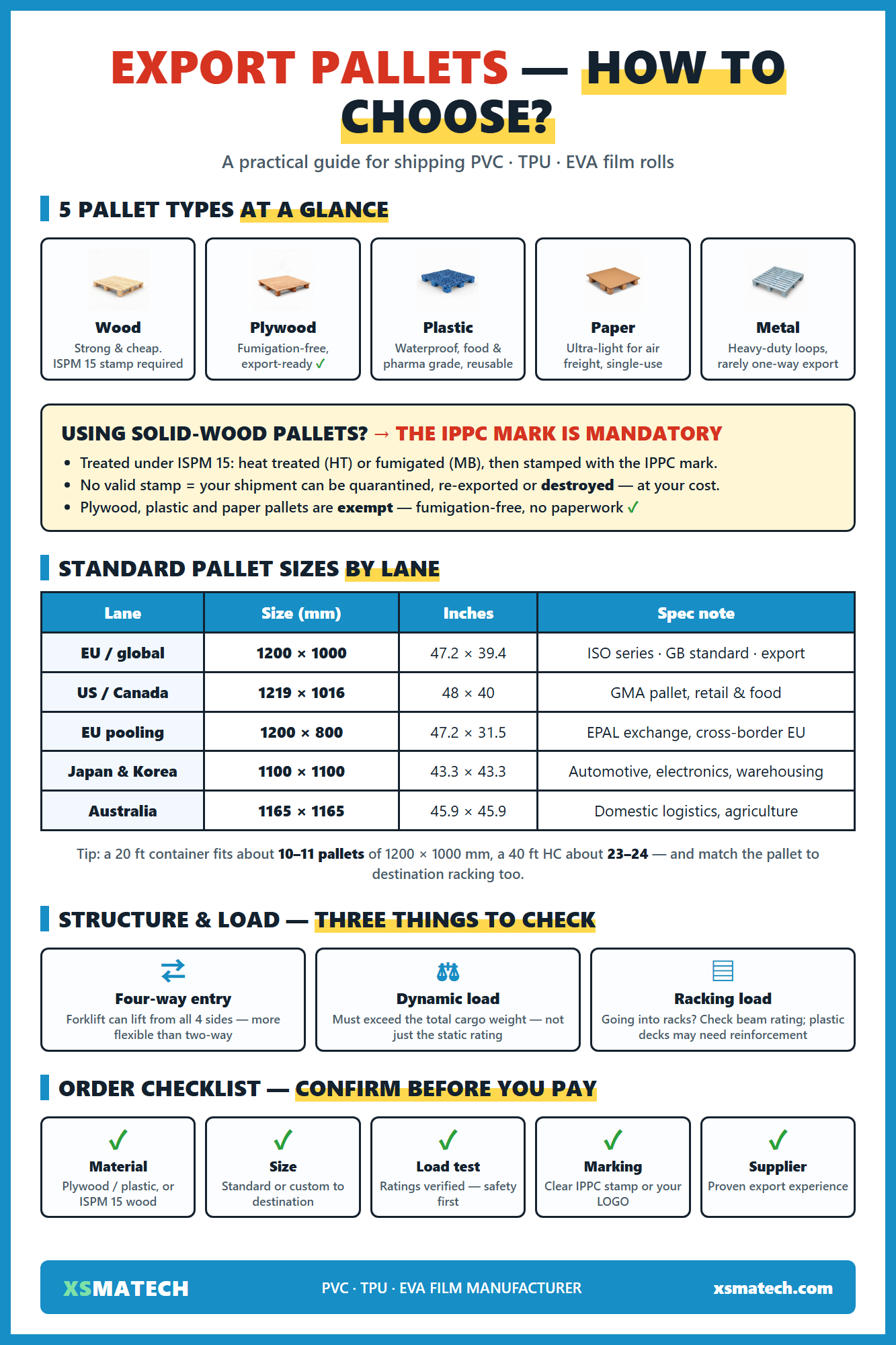
The five common pallet types
| Type | Strengths | Watch-outs |
|---|---|---|
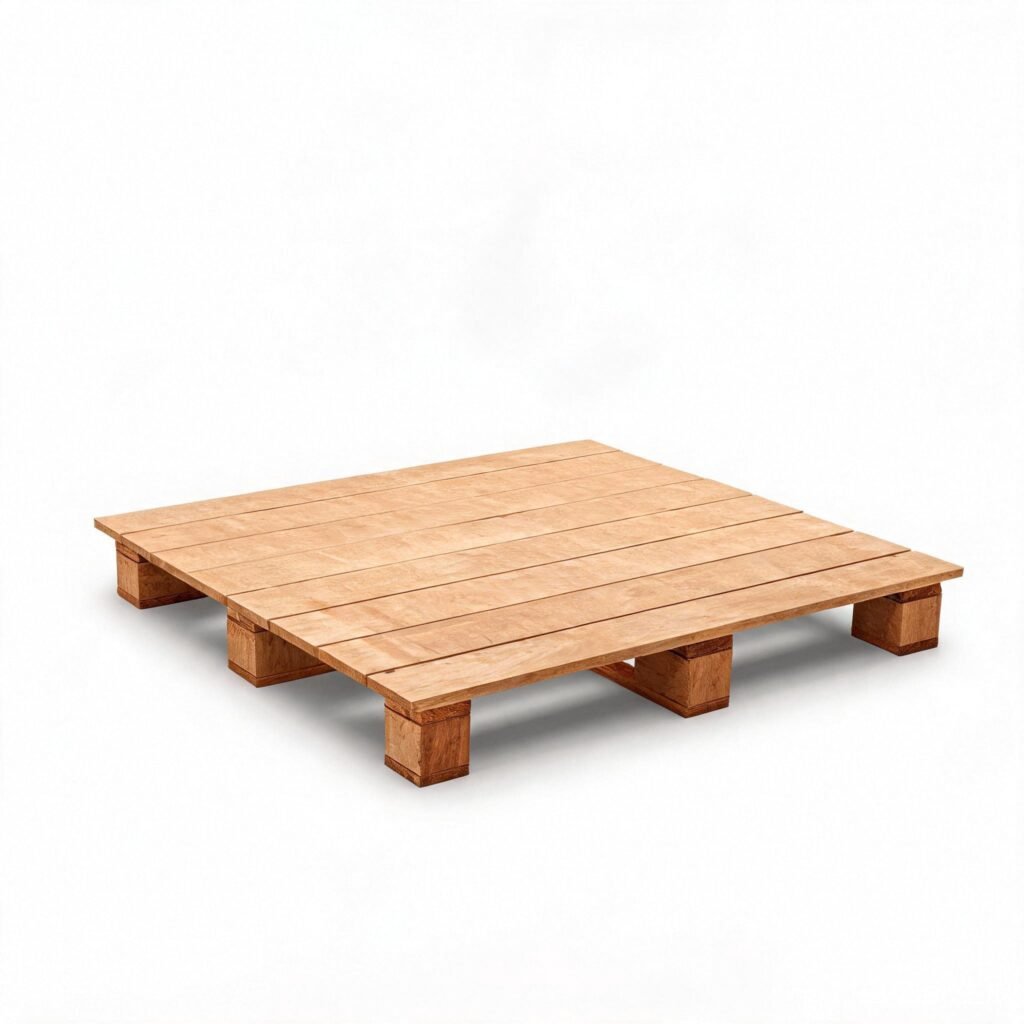
| Wood | Lowest cost, strong, easy to source | Must be ISPM 15 treated and IPPC stamped (HT or MB) |
| Plywood | Fumigation-free, flat and clean deck, no paperwork | Slightly pricier than raw solid wood |
| Plastic | Waterproof, food/pharma grade, reusable, long life | Higher unit cost (typically 2–4× wood) |
| Paper / honeycomb | Ultra-light, recyclable — ideal for air freight | Single-use, limited load capacity |
| Metal (steel/aluminium) | Extreme durability and hygiene | Expensive; normally only for closed rental/loop systems |
ISPM 15 and the IPPC mark, in plain words
ISPM 15 is the international standard that governs solid-wood packaging material — pallets, crates and dunnage. Solid-wood pallets must be debarked and then either heat treated (HT), so the wood core reaches 56 °C for at least 30 minutes, or fumigated with methyl bromide (MB) — and stamped with the official IPPC mark: the IPPC logo plus country code, producer number and treatment code.
Arrive without a valid stamp and customs can order treatment at the port, re-export the shipment, or destroy it — all at the importer’s cost. One thing buyers often miss: the rule covers the wood packaging, not your goods. PVC, TPU and EVA film never need fumigation. The simplest way to sidestep the whole topic is to pick a pallet that is exempt by design:
- Plywood / engineered-wood pallets — boards manufactured with heat, glue and pressure fall outside ISPM 15, so they ship fumigation-free with no certificates. This is the default export pallet for many film exporters.
- Plastic pallets — no wood at all, nothing to treat; the choice for food and pharma end-uses.
- Paper pallets — same exemption, plus very light, which matters when every kilo is air-freight cost.
Standard pallet sizes by destination
| Region | Standard size (mm) | Inches | Typical use |
|---|---|---|---|
| North America | 1219 × 1016 | 48 × 40 | Retail, food, general logistics |
| Europe | 1200 × 800 (EPAL) | 47.2 × 31.5 | EPAL pool, cross-border EU logistics |
| China | 1200 × 1000 | 47.2 × 39.4 | GB national standard, export, EU-compatible |
| Japan & Korea | 1100 × 1100 | 43.3 × 43.3 | Automotive, electronics, local warehouses |
| Australia | 1165 × 1165 | 45.9 × 45.9 | Domestic logistics, agriculture |
Tip: match the pallet to the destination’s racking and handling system, not just to the container. For container planning, a 20 ft container fits roughly 10–11 pallets of 1200 × 1000 mm in a single layer, and a 40 ft HC about 23–24, depending on pallet height and stacking.
A quick lane shorthand used by most exporters: EU / global lanes → 1200 × 1000 mm (ISO series, GB standard, EU-compatible); US / Canada lanes → 48 × 40 in (the classic GMA pallet); EU pooling → EPAL 1200 × 800; Japan & Korea → 1100 × 1100 mm. If your warehouses use standard racks, stay standard — a custom size always costs more and limits where the pallet can go.
Structure and load ratings: three things to check
- Entry type — four-way beats two-way. A four-way entry pallet can be lifted by a forklift or pallet truck from all four sides, which speeds up loading, unloading and re-positioning in tight destination warehouses. Two-way pallets are cheaper but far less flexible.
- Dynamic load, not just static. Pallets carry three ratings: static (stacked at rest), dynamic (while being moved) and racking (supported only at the beams). The dynamic rating must exceed the total weight of your goods — a pallet of film rolls is lifted, tilted and braked many times before it reaches your warehouse.
- Racking load if it goes on shelves. If the pallets will be stored in racking, confirm the rack-beam load and the pallet’s racking rating — plastic pallets, in particular, may need a reinforced version (or steel tubes inside) to span the beams safely.
How XSMATECH packs film rolls for export
- Each roll is bagged in PE with end protection, then packed into cartons.
- Rolls are palletized straight and aligned, with edge boards under every strap.
- Stretch wrap and PET strapping lock the load; desiccant bags guard against container rain.
- Default pallet: fumigation-free plywood or plastic — no ISPM 15 paperwork, no fumigation delay. ISPM 15 HT solid-wood pallets are available on request for cost-optimized lanes.
That packing protects the whole product range: PVC film, TPU film, EVA / PEVA film and glitter sheets.
Pre-order checklist: confirm these before you pay
- Material and fumigation: plywood/plastic (fumigation-free) or ISPM 15 HT solid wood — agreed per destination.
- Size check: standard size for the lane, or a confirmed custom spec (price, lead time and where it can be used).
- Load ratings tested: static, dynamic and racking ratings documented — safety comes first, and a collapsed pallet is never cheaper.
- Marking: clear IPPC stamp on wood, or your own company LOGO if you want branded pallets.
- Supplier with export experience: someone who ships film to your market regularly will already know the pallet, certificate and container pitfalls.
- Food, pharma or medical end-uses: specify plastic or plywood — never raw wood.
- Loading plan in writing: pallet count per 20 ft / 40 ft HC, stackable or not.
FAQ
Do PVC, TPU or EVA films need fumigation?
No. ISPM 15 regulates wood packaging material only, and film is exempt. But the pallet under it may not be — which is exactly why we default to fumigation-free pallets.
Which pallet should I use for Australia?
Australia enforces ISPM 15 strictly and is very sensitive to bark and live insects. Use plywood or plastic pallets, or ISPM 15 HT wood with a clean, bark-free stamp.
Can you pack on our pallet spec?
Yes. Send us the size, load rating and style (two-way/four-way entry, deck type) and we will palletize to your spec — just mention it when you request a quote on the contact page.
Does the pallet change the film price?
Only marginally. Pallet choice barely moves product price, but it changes volumetric weight for air freight and the container fill rate — both worth confirming in the loading plan.
Need packing details for your lane, or ready-to-ship rolls this week? Browse the ready-to-ship stock list, pull material data from the datasheets page, or talk to XSMATECH — we quote EXW, FOB, CIF and DDP with packing optimized per destination.