
Most suppliers show you a render and a promise. We publish our lab numbers. Below are the actual physical properties of our 85A transparent TPU film in four production thickness grades (0.15 / 0.2 / 0.25 / 0.3 mm), measured in our own factory laboratory — and a plain-English guide to what each number means for your product.
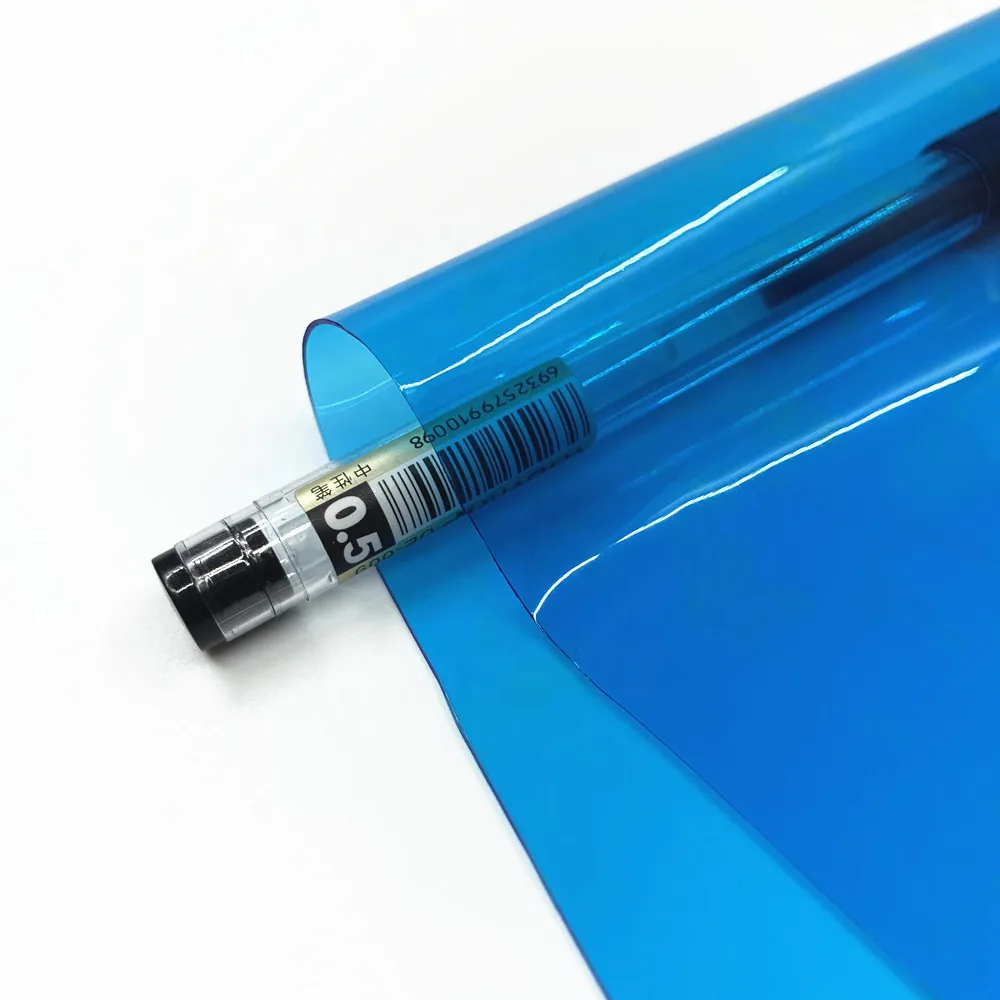


The grades at a glance
| Grade | Hardness | Tensile strength (MD) | Elongation at break (MD) | Melting point | Specific gravity |
|---|---|---|---|---|---|
| TPU 85A 0.15 mm | Shore A 87 | 71.9 MPa | 538.8% | 143°C | 1.21 g/cm³ |
| TPU 85A 0.2 mm | Shore A 88 | 63.5 MPa | 699.2% | 140°C | 1.21 g/cm³ |
| TPU 85A 0.25 mm | Shore A 90 | 58.3 MPa | 543.4% | 138°C | 1.21 g/cm³ |
| TPU 85A 0.3 mm | Shore A 90 | 39.5 MPa | 735.8% | 138°C | 1.21 g/cm³ |
Test methods: gauge thickness Teclock SM-114; hardness ASTM D2240; tensile and elongation ASTM D412 (type C); tear ASTM D624. Conditioned 8+ hours at room temperature, tested at 26°C / 41% RH on a GX-8002 tensile machine. Transverse (CD) values included in the full datasheets.
Tensile strength 39.5 – 71.9 MPa: the thinner, the stronger
Notice the pattern: our thinnest grade (0.15 mm) is also the strongest at 71.9 MPa — and strength decreases as thickness increases. That is normal for TPU films, and it matters when you choose: if your product needs a thin film that still resists tearing under load (watch straps, inflatable seams, high-stress linings), the 0.15 – 0.2 mm grades deliver the best strength-to-weight ratio. For volume, conformability and soft hand feel, the 0.25 – 0.3 mm grades trade some strength for flexibility.
Elongation 538 – 736%: flex without cracking
Elongation at break above 500% means the film stretches to more than five times its length before failing. In practice: seams survive inflation and flexing, bags survive repeated opening, and laminated composites absorb stress without delaminating. If your application cycles (inflatables, wearables, folding panels), elongation is the number to watch — and all four grades clear 500% comfortably.
Tear strength: 116 – 163 kgf/cm across the range
Tear propagation is where thin films usually fail first. Our 85A grades test between 116 and 163 kgf/cm (ASTM D624, nicked die), with the transverse direction consistently stronger — useful to know when you orient panels or seams. Combined with high-frequency weldability, this makes the film suitable for inflatable and welded constructions, not just sewn ones.
How we test (and why it is transparent)
Every production batch can be verified: specimens conditioned over 8 hours at room temperature, tested on a GX-8002 tensile machine at 26°C and 41% RH, with gauge thickness measured on a Teclock SM-114. The full datasheets (PDF, bilingual) list both machine-direction and transverse values — no cherry-picking, no renders. If your engineering team wants to reproduce the numbers, the methods are all standard ASTM.
Get all four datasheets
The complete test reports for all four thickness grades are available as downloadable PDFs — grab them from our datasheets page by entering your email. For other hardness grades (85A – 95A), thicknesses (0.05 – 2.0 mm) or colors, we custom-produce with free samples.
Compare the lab data against your spec: send us your application — we will match the grade and ship samples.