
Two numbers decide most of how a flexible PVC film behaves in your product: thickness and hardness. Get them right and conversion is smooth, welds hold and the product feels right in the hand. Get them wrong and no amount of surface finish will save the job. Here is how buyers should think about both.
What thickness actually controls
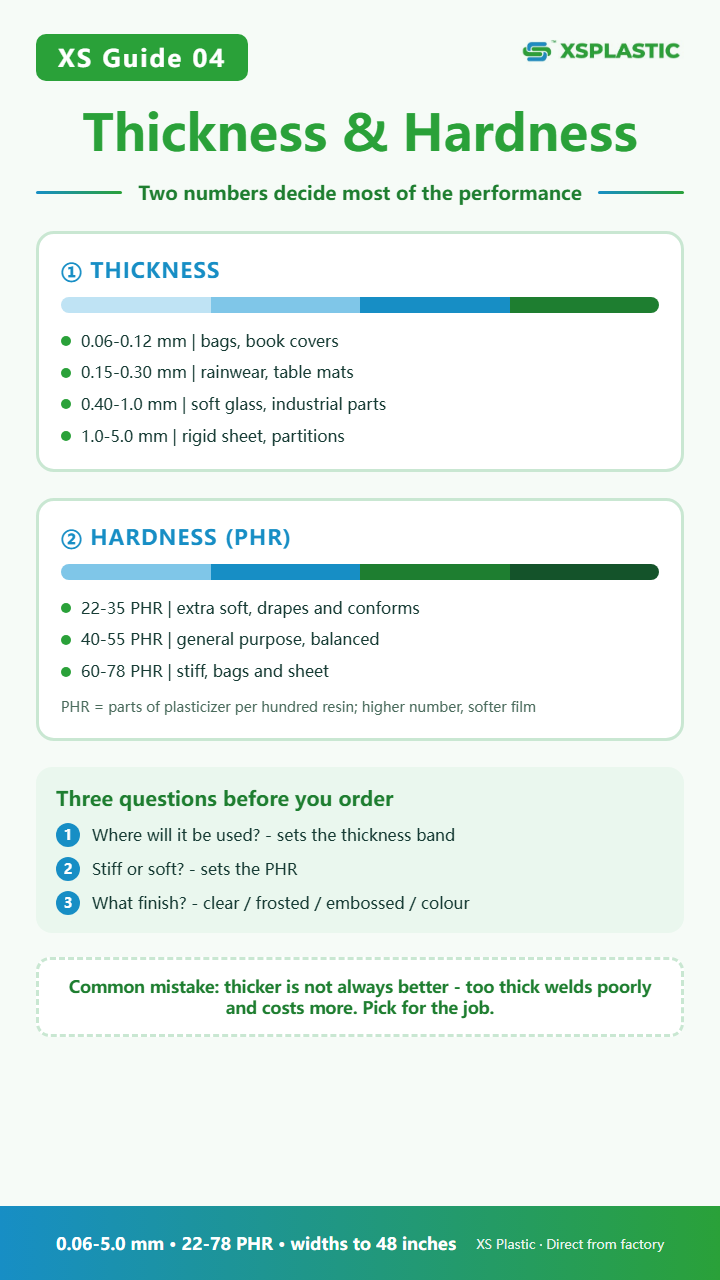
Thickness drives cost (film is sold by weight or length), stiffness, transparency, weld strength and how the product drapes. Thin film folds easily and welds fast; thicker film adds body, durability and a premium feel – up to the point where it stops welding cleanly and the price climbs.
Thickness bands by application
Most flexible PVC products fall into four bands:
| Band | Typical products | Notes |
|---|---|---|
| 0.06 – 0.12 mm | Zipper bags, garment bags, book covers | Fast HF welding, lowest cost per bag |
| 0.15 – 0.30 mm | Raincoats, table mats, pouches | Balance of drape and durability |
| 0.40 – 1.0 mm | Soft glass, industrial covers, stationery boxes | Body without rigidity |
| 1.0 – 5.0 mm | Sheet goods, partitions, flooring | Calendered or extruded sheet |
Treat the bands as starting points. If your conversion line already runs well at one thickness, keep it – switching thickness is a process change, not just a material change.
Hardness: what PHR means
PVC hardness is usually specified in PHR – parts of plasticizer per hundred parts of resin. More plasticizer means a softer, more flexible film. Practical bands:
- 22 – 35 PHR: extra soft, drapes and conforms – stretch covers, soft pouches, clings to curves.
- 40 – 55 PHR: the workhorse range – rainwear, table protectors, general bags.
- 60 – 78 PHR: stiff and firm – bag panels that must hold shape, box inserts, semi-rigid sheet.
Hardness also moves weld behaviour: softer films weld at lower energy, stiffer films need more, and very stiff stock behaves closer to rigid sheet.
Matching hardness to the product
Ask one question: should the finished part hold a shape or follow a shape? Bags and box inserts must hold – go stiffer (60+ PHR). Table protectors and raincoats follow – stay mid-range. Anything that wraps or clings goes soft. If two parts of one product need different feels, two hardnesses in the same colour and finish usually look identical and convert differently.
How to write the spec in your RFQ
Three lines are usually enough for a first quotation:
- Application (what the film becomes in your factory).
- Thickness band (e.g. 0.15 – 0.20 mm) and width.
- Feel target (e.g. “soft, drapes like the sample” or “stiff enough to stand”) plus finish – clear, frosted, embossed or colour with a Pantone code.
A supplier who answers with a real PHR number and a tolerance, not just “soft”, is a supplier who controls compounding in-house.
Common mistakes
- Ordering thicker “for safety” – welds get harder, costs rise, and the product feels stiff.
- Specifying hardness by brand-name feel words instead of PHR – two factories will not match.
- Ignoring tolerance: ±0.01 mm matters more than the nominal number on a fast line.
Have a project in mind?
Send us an inquiry with your target thickness and PHR, browse the stock list for ready-to-ship rolls, or request free samples to test on your own machines. A Vietnamese version of this article is coming soon.